

Supply only moves in one direction
Usage funds the burn. The burn tightens supply.
MCR is a deflationary token. Monochrome commits to a structured, profit-funded buy-back and burn that permanently removes MCR from circulation. It is the mechanism the leading exchange tokens proved to be the primary driver of long-term value.The mechanism
Every quarter, 20% of net platform profit is allocated to buying MCR on the open market. All MCR bought back is permanently destroyed at a burn address no one controls.
Because the buy-back is funded by real platform profit, the amount burned grows as the platform grows.
Contingent burns
On top of the base quarterly round:- Launchpad and Digital IPO revenue. 25% of Monochrome’s platform fee revenue from every Launchpad offering and Digital IPO is added to that quarter’s burn.
- Deprecated products. If a product line is retired, any MCR held in reserve against it is burned in the following round.
Built to be verified
The credibility of a profit-funded burn rests entirely on verifiability. Monochrome commits to:1
A published, fixed formula
20% of net profit, quarterly. Rule-based, not discretionary.
2
A single, immutable burn address
Published in advance. Anyone can verify the cumulative amount removed from supply on a block explorer, at any time.
3
A public burn ledger
Every round recorded: round number, execution window, average purchase price, MCR purchased, MCR burned, cumulative supply reduction, and the transaction link.
4
Independent quarterly attestations
From the first full fiscal quarter of operation, an independent third party confirms each burn matches 20% of reported net profit.
The flywheel
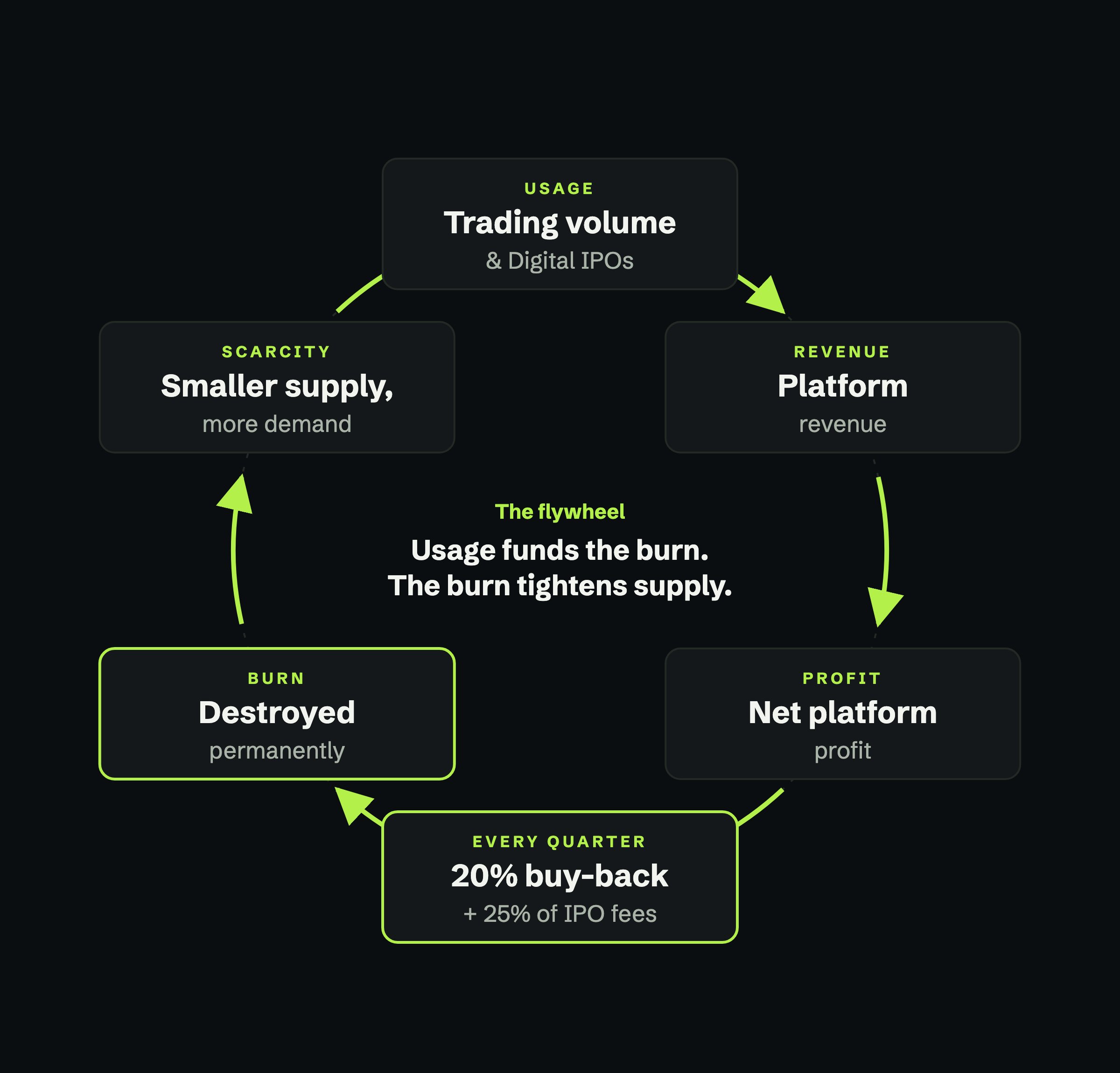
1
Usage
Trading across spot and derivatives markets, together with Launchpad offerings and Digital IPOs, generates platform fees.
2
Revenue and profit
Those fees are platform revenue. What remains after costs is net platform profit, reported in reviewed quarterly financial statements.
3
Buy-back
Every quarter, 20% of that net profit buys MCR on the open market. 25% of Launchpad and Digital IPO fee revenue is added on top.
4
Burn
Everything bought back is sent to the burn address and permanently removed from supply.
5
Scarcity
Supply was fixed at 210,000,000 at issuance and can only fall. Each round leaves fewer MCR to serve the same, or greater, platform demand.
6
Demand
Holding MCR is how participants trade cheaper, get into every Launchpad offering and Digital IPO, earn staking rewards, and qualify as a node. As the platform grows, more participants need MCR, which means more usage, and the loop turns again.
Why it compounds
- The burn scales with the business. It is a fixed share of profit, not a fixed number of tokens, so a larger platform burns more MCR each quarter.
- Digital IPOs turn the loop twice. Each issuance creates subscription demand, because investors hold or stake MCR at snapshot, and burn demand, because 25% of the fee revenue goes to that quarter’s burn.
- Holding is never consumed. Participating in an offering does not spend MCR. Demand for the token accumulates rather than churning.
- Staking and nodes take supply off the order book. MCR staked for rewards and allocation weight is locked for its term, and node tiers require a held balance, so a share of supply sits outside day-to-day trading while the burn reduces the total.
The buy-back and burn is a supply-management mechanism funded by platform profit. It is not a dividend, a profit distribution, or a payment to holders. Holders benefit only from any market-value effect of a reduced circulating supply.
First burn round: Q1 2027
Covering Q4 2026 platform results, with the first public ledger entry and independent attestation.